


7 or 14 spoke wheels designs how possible?


Thread Starter
Joined: Jul 2010
Posts: 884
Likes: 2
 7 or 14 spoke wheels designs how possible?

This is just a general wheel question that just had me wondering if there was a definite answer to?
I am really liking 14 spoke mesh wheel designs like the TWS Nurburgring and Apex EC-7 for BMW's but since you can't split a circle equally into 7 or 14 parts how is this style wheel mathematically physically possible without some kind of imbalance?
360÷7= 51.4285714286
360÷14= 25.7142857143
in comparison to
360÷3=120,360÷4=90 360÷5=72, etc...
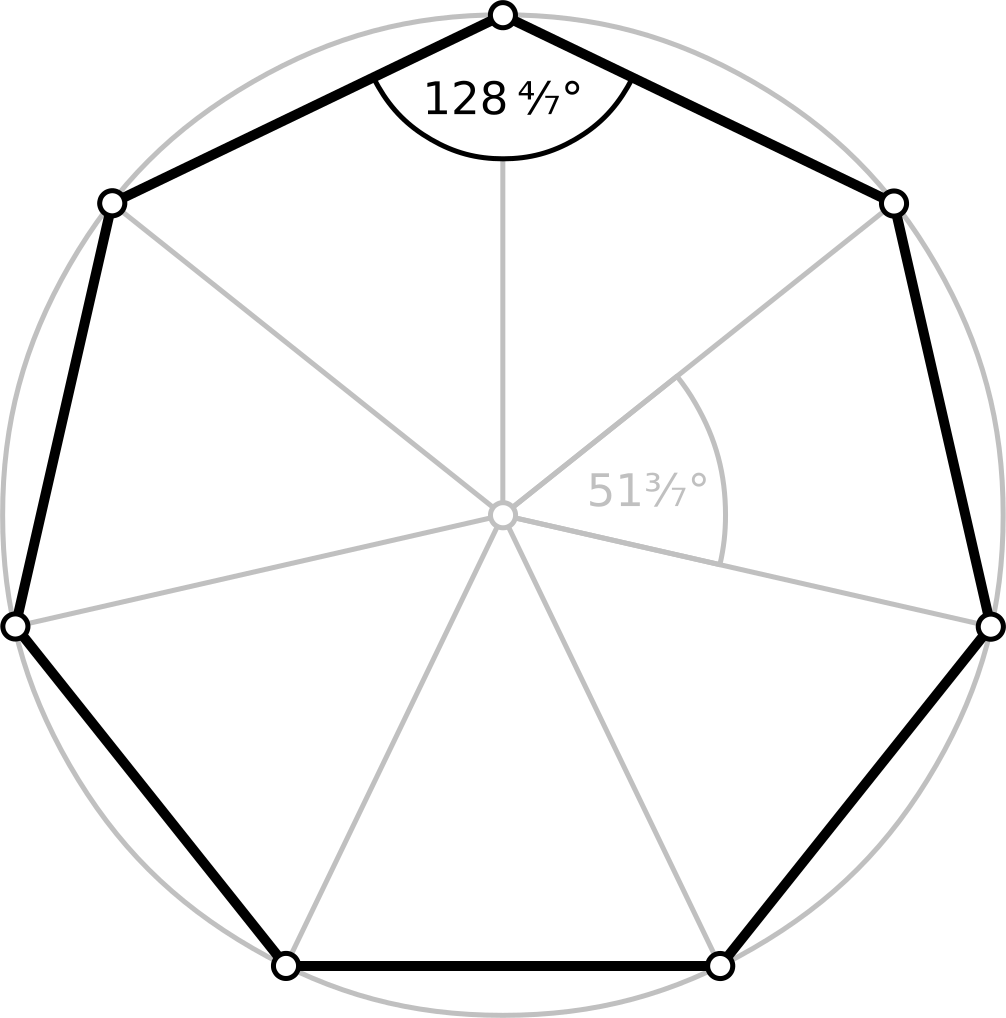
I know a heptagon is constructed with 7 equal sides, could that be the reason for a 7/14 spoke wheel?
Thanks


Registered User
Joined: Apr 2008
Posts: 796
Likes: 1
Just because the angles are all decimals doesn't make them all not equal. If all the angles are equal and constrained by the same size circle, all the pie slices are equal. Period.
You can divide a circle into as many slices as you want, the real question is how close can you hold your manufacturing tolerances and how close in line your rotation axis is with the inertial axis. That'll drive how "well balanced" a wheel is.
You can divide a circle into as many slices as you want, the real question is how close can you hold your manufacturing tolerances and how close in line your rotation axis is with the inertial axis. That'll drive how "well balanced" a wheel is.

Joined: Apr 2009
Posts: 2,521
Likes: 1
From: Renton, WA
The center of mass of the seven spokes still ends up in the middle of the circle.
I made a quick CAD model. Assume each spoke is 5" long and offset 2" from the "center". center of circle is coordinates (0,0).
Center of mass of the first spoke pointing straight up: (4.5, 0) (half of 5" plus the 2" offset is 4.5")
next spoke going clockwise: (2.8057, 3.5182)
#3: (-1.0013, 4.3872)
#4: (-4.0544, 1.9525)
#5: (-4.0544, -1.9525)
#6: (-1.0013, -4.3872)
#7: (2.8057, -3.5182)
Now add up all these centers of mass:
The first column: 4.5 + 2.805 - 1.001 -4.0544 - 4.0544 - 1.0013 + 2.8057 = 0
The second column: 0 + 3.518 +4.387 + 1.952 - 1.952 - 4.387 - 3.518 = 0
So in the end the center of mass still equals (0,0) which is at the center of the wheel, so the wheel is balanced. Even though the spokes are not visually "symmetrical".
I made a quick CAD model. Assume each spoke is 5" long and offset 2" from the "center". center of circle is coordinates (0,0).
Center of mass of the first spoke pointing straight up: (4.5, 0) (half of 5" plus the 2" offset is 4.5")
next spoke going clockwise: (2.8057, 3.5182)
#3: (-1.0013, 4.3872)
#4: (-4.0544, 1.9525)
#5: (-4.0544, -1.9525)
#6: (-1.0013, -4.3872)
#7: (2.8057, -3.5182)
Now add up all these centers of mass:
The first column: 4.5 + 2.805 - 1.001 -4.0544 - 4.0544 - 1.0013 + 2.8057 = 0
The second column: 0 + 3.518 +4.387 + 1.952 - 1.952 - 4.387 - 3.518 = 0
So in the end the center of mass still equals (0,0) which is at the center of the wheel, so the wheel is balanced. Even though the spokes are not visually "symmetrical".


 and there you have it folks





Trending Topics



Thread
Thread Starter
Forum
Replies
Last Post