


Definition of "MID-ENGINE"


Registered User

Joined: Oct 2000
Posts: 3,827
Likes: 0
From: Bay Area

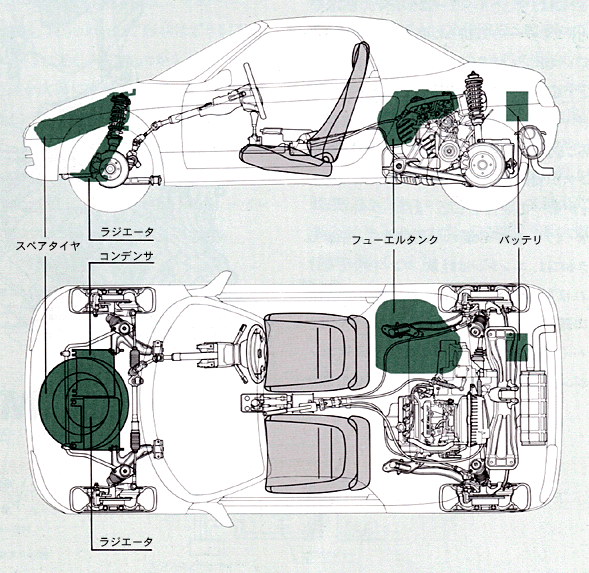
It seems that exceltoexcel is searching all the threads and "correcting" all mentions of "mid-engine" cars. In a separate (old) thread, I called this car mid-engine and exceltoexcel claims that this car is not a mid-engine design. I'd like to get some other opinions on whether this is mid-engine by exceltoexcel's own definitions:


Registered User
Joined: Nov 2001
Posts: 594
Likes: 0
From: Rochester
Is it any more stupid than the endless debates over the definition of a "sports car"?
As many have said, if it is or isn't mid-engine, so what?
Moving the front engine towards the middle presumably gives both a closer to 50/50 weight balance and lower polar moment of inertia. Good.
Whether front/mid-engined cars fit the classic mid-engine definition, I don't think they'll perform quite the same as "real" mid-engined cars [ducking]. Those usually have a c. 40/60 or so weight distn. I believe this is superior for high performance braking and accel in higher powered cars.
As many have said, if it is or isn't mid-engine, so what?
Moving the front engine towards the middle presumably gives both a closer to 50/50 weight balance and lower polar moment of inertia. Good.
Whether front/mid-engined cars fit the classic mid-engine definition, I don't think they'll perform quite the same as "real" mid-engined cars [ducking]. Those usually have a c. 40/60 or so weight distn. I believe this is superior for high performance braking and accel in higher powered cars.

Banned
Joined: Dec 2003
Posts: 3,319
Likes: 0
From: City
How dumb. Front-engine cars have the engine in the front. Rear-engine cars have the engine behind the passenger compartment, and to further differentiate, placement relative to the rear axle determines whether it is a mid-engined or rear-engined auto.
Name one car with the engine in front of the front axle. Most all FWD cars have the engine placed on top of the front axle, or behind it. Virtually all front-engine, RWD cars have the bulk of the engine behind the front axle. There is nothing special about the S2000's engine placement, except it is the only RWD, front-engine car Honda makes. I'm sure to their engineers, it is new and different, but that is only compared to the FWD cars they make.
If placement of the engine over the rear axle makes a car mid-engined, and you want to apply the same rules to the front axle, then all cars with the engine in front are mid-engined. Of course, if you go around telling people your S2000 or Civic is mid-engined, they will laugh at you for being so ignorant. But go right ahead.
Name one car with the engine in front of the front axle. Most all FWD cars have the engine placed on top of the front axle, or behind it. Virtually all front-engine, RWD cars have the bulk of the engine behind the front axle. There is nothing special about the S2000's engine placement, except it is the only RWD, front-engine car Honda makes. I'm sure to their engineers, it is new and different, but that is only compared to the FWD cars they make.
If placement of the engine over the rear axle makes a car mid-engined, and you want to apply the same rules to the front axle, then all cars with the engine in front are mid-engined. Of course, if you go around telling people your S2000 or Civic is mid-engined, they will laugh at you for being so ignorant. But go right ahead.

Joined: Mar 2001
Posts: 37,305
Likes: 18
I still think a Porsche Boxster looks like it going backwards all the time, so does that make it a front engined car? 
You know those toothpicks that have a point on each end? I use the FRONT end for picking my teeth and the REAR end for cleaning my finger nails!
(Can you guess at the importance I place on this threads debate? )
)
You know those toothpicks that have a point on each end? I use the FRONT end for picking my teeth and the REAR end for cleaning my finger nails!
(Can you guess at the importance I place on this threads debate?
)

Registered User
Joined: Oct 2001
Posts: 228
Likes: 0
From: Chicago
I believe that the largest handling/cornering benefit of a mid-engined car is the low polar moment that this configuration brings about (i.e. a car with a low polar moment should be able to transition and rotate on its axis more efficiently than a car with a higher polar moment). This is why so many mid-engined cars can negotiate slaloms so effectively.
Traditional mid-engined cars like the Ferrari 328, 355, or 360 or Porsche 550, 914, 986 by design will enhance this benefit more than "front-mids" like the S2000/RX8 etc. simply because they centralize the driver/engine mass more efficiently than a front-mid configuration. For example if you removed the engine fire wall in all of the above cars the mid-engined drivers could literally reach a hand just behind their hips to touch the engines. On the other hand the front-mid drivers probably could not touch their engines even if they reached forward as far possible.
If someone has the figures available, it would be interesting to compare the "polar moments" of a few "front mids" like the S2000, RX8, etc. with some mid-engined cars like the 986, MR2, Ferrari 360 etc.
Do any of you have this info available? Just curious.....
Traditional mid-engined cars like the Ferrari 328, 355, or 360 or Porsche 550, 914, 986 by design will enhance this benefit more than "front-mids" like the S2000/RX8 etc. simply because they centralize the driver/engine mass more efficiently than a front-mid configuration. For example if you removed the engine fire wall in all of the above cars the mid-engined drivers could literally reach a hand just behind their hips to touch the engines. On the other hand the front-mid drivers probably could not touch their engines even if they reached forward as far possible.
If someone has the figures available, it would be interesting to compare the "polar moments" of a few "front mids" like the S2000, RX8, etc. with some mid-engined cars like the 986, MR2, Ferrari 360 etc.
Do any of you have this info available? Just curious.....