


Bridged mode of 4-Channel amp


Thread Starter
Registered User
Joined: Dec 2003
Posts: 1,774
Likes: 0
From: Irvine, SoCal
 Bridged mode of 4-Channel amp
I am thinking about buying 2-channel amp to drive rear speakers, and using 4-channel amp in bridged mode to drive front speakers. I would like to confirm the wiring of bridged mode as follow:
Negative (-) of left rear channel to Negative (-) of front left speaker
Positive (+) of right rear channel to Positive (+) of front left speaker
Negative (-) of left front channel to Negative (-) of front right speaker
Positive (+) of right front channel to Positive (+) of front right speaker
Left RCA cable from HU to Rear Amp RCA input
Right RCA cable from HU to Front Amp RCA input
Speaker connections are logical, but RCA connections seem odd to me. What's wrong ?
Negative (-) of left rear channel to Negative (-) of front left speaker
Positive (+) of right rear channel to Positive (+) of front left speaker
Negative (-) of left front channel to Negative (-) of front right speaker
Positive (+) of right front channel to Positive (+) of front right speaker
Left RCA cable from HU to Rear Amp RCA input
Right RCA cable from HU to Front Amp RCA input
Speaker connections are logical, but RCA connections seem odd to me. What's wrong ?

Former Moderator
Joined: Jun 2003
Posts: 18,852
Likes: 1
From: New York
Im no expert in this....as this requires a bit of home audio knowledge....Phil will give you a definite answer....but I believe....assuming you got your front left and front right RCAs.....if you get a Y splitter for the RCAs...then you would have 2 rights, and two lefts....thus making your amp deliver the same sound on all channels

http://www.radioshack.com/product.asp?cata...ct%5Fid=274-511
http://www.radioshack.com/product.asp?cata...ct%5Fid=274-511


Joined: Mar 2003
Posts: 79,195
Likes: 18
From: Home
RCA's are pretty easy. They come in pairs one for right, and one for left. So your HU should have a total of 6. Front (R/L) Rear (R/L) and Sub.
You would run the front set to your 4-channel amp and the rear to your 2-channel amp.
I am not sure about the bridge mode, but I believe it can be different of different amps. Do you have a Make and Model available?
BTW -- What I think you are trying to do is bridge the two right channels together AND the two left channels together so I doubt you would want to bridge anything from the right to the left. Otherwise you lose all balence controls. By bridging the left channels (Front and Back) you would loose fade control (Which since you are not running front to back off this amp is not a problem.)
Depending on the amp, you probably need to put an input to all 4 channels in order for the bridge to do anything for you. In that case, I would suspect that Dave is showing you the correct part to split your front R/L signals into identical Front and Rear signals (different from right to left.) So you would get two of the connectors shown above. Connected the 1 side to the RCA coming FROM the HU and then run two RCAs from that connector to the AMP and connect to front and rear. Then do the same for the other side.
I hope this makes SOME sense.
You would run the front set to your 4-channel amp and the rear to your 2-channel amp.
I am not sure about the bridge mode, but I believe it can be different of different amps. Do you have a Make and Model available?
BTW -- What I think you are trying to do is bridge the two right channels together AND the two left channels together so I doubt you would want to bridge anything from the right to the left. Otherwise you lose all balence controls. By bridging the left channels (Front and Back) you would loose fade control (Which since you are not running front to back off this amp is not a problem.)
Depending on the amp, you probably need to put an input to all 4 channels in order for the bridge to do anything for you. In that case, I would suspect that Dave is showing you the correct part to split your front R/L signals into identical Front and Rear signals (different from right to left.) So you would get two of the connectors shown above. Connected the 1 side to the RCA coming FROM the HU and then run two RCAs from that connector to the AMP and connect to front and rear. Then do the same for the other side.
I hope this makes SOME sense.
Thread Starter
Registered User
Joined: Dec 2003
Posts: 1,774
Likes: 0
From: Irvine, SoCal
My current amp is Memphis 16-MC2004, it is 4-channel amp bridgable to drive 2 channel with higher power. It is rated at 50WrmsX4 @ 4 Ohms, Bridged mode: 75WrmsX2 @ 4 Ohms(?)
I were thinking about the the same Y splitter to split the front RCA to two pairs. Is this the right connections ?
Two right are connected to Front RCA inputs ?
Two left are connected to Rear RCA inputs ?
Front speaker outputs are bridged to drive Front Left speaker
Rear speaker outputs are bridged to drive Front Right speaker
This seemingly simple problem can be so confusing
Anyone that had done this wiring and still retain the balance control of the front speakers, please show the wiring diagram from HU to 4-channel amp
I were thinking about the the same Y splitter to split the front RCA to two pairs. Is this the right connections ?
Two right are connected to Front RCA inputs ?
Two left are connected to Rear RCA inputs ?
Front speaker outputs are bridged to drive Front Left speaker
Rear speaker outputs are bridged to drive Front Right speaker
This seemingly simple problem can be so confusing
Anyone that had done this wiring and still retain the balance control of the front speakers, please show the wiring diagram from HU to 4-channel amp
Thread Starter
Registered User
Joined: Dec 2003
Posts: 1,774
Likes: 0
From: Irvine, SoCal
Anyone done the bridged mode to double the amp power to drive front speakers without losing balance control nor losing stereo ?
If I am buying 2-channel amp to drive the rear speakers, and using 4-channel amp to drive front speakers, how do I connect the front RCA outputs of the HU to 4-channel amp to retain stereo signal and balance control ? Help please.
If I am buying 2-channel amp to drive the rear speakers, and using 4-channel amp to drive front speakers, how do I connect the front RCA outputs of the HU to 4-channel amp to retain stereo signal and balance control ? Help please.

Registered User
Joined: Oct 2002
Posts: 7,584
Likes: 1
From: Baton Rouge, LA
first things first -- methods of bridging are HIGHLY dependant upon the manufacturer and will vary from amp to amp. so, we almost HAVE to have your manual to do this properly.
2nd.
let's talk briefly about what bridging is... this is really going to be sloppy and while mostly technically correct - i'm trying to simplify as much as i can b/c there is a lot of misunderstanding about this topic. moving on...
hopefully, we all know that sound waves (and the electronic signals that become sound waves) are waves that oscillate around a baseline 'center' of the wave.
for the normal amp, that center is the ground and the wave is measured in voltage. the wave represents the positive portion of the signal and the ground represents the negative.
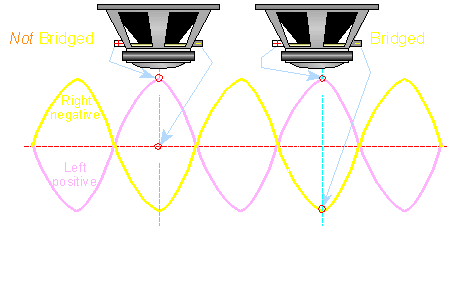
now -- when you BRIDGE an amp, what happens is you duplicate the input signal and input it in 2 ways: both in a normal and INVERTED form. (9 times of 10, the amp inverts the signal for you based on switches, wiring configurations, whatever).
what heppens to the inverted the signal is now you have a 2nd signal identical but exactly opposite of the main signal. the amp then uses the INVERTED (and opposite) signal as the negative and the normal signal as the positive. this essentially DOUBLES the magnitude of the signal (which, i hope you remember is in volts).
this picture illustrates that:
now, the power your output from the amp is based upon the formula P = (V^2) / R
so, if we've DOUBLED the voltage, we've multiplied it by 2. as you can see by the formula above, if we double the voltage, it is then squared... so the power is actually multiplied by a factor of 4.
this assumes your amp can 'scale' w/o limitations... often, the amp will be limited, and you won't get a perfect increase by 4.
the real detailed and accurate explanation is here: http://www.bcae1.com/bridging.htm
now on to the question:
[QUOTE]Originally posted by TR-S2K
I am thinking about buying 2-channel amp to drive rear speakers, and using 4-channel amp in bridged mode to drive front speakers. I would like to confirm the wiring of bridged mode as follow:
Negative (-) of
2nd.
let's talk briefly about what bridging is... this is really going to be sloppy and while mostly technically correct - i'm trying to simplify as much as i can b/c there is a lot of misunderstanding about this topic. moving on...
hopefully, we all know that sound waves (and the electronic signals that become sound waves) are waves that oscillate around a baseline 'center' of the wave.
for the normal amp, that center is the ground and the wave is measured in voltage. the wave represents the positive portion of the signal and the ground represents the negative.
now -- when you BRIDGE an amp, what happens is you duplicate the input signal and input it in 2 ways: both in a normal and INVERTED form. (9 times of 10, the amp inverts the signal for you based on switches, wiring configurations, whatever).
what heppens to the inverted the signal is now you have a 2nd signal identical but exactly opposite of the main signal. the amp then uses the INVERTED (and opposite) signal as the negative and the normal signal as the positive. this essentially DOUBLES the magnitude of the signal (which, i hope you remember is in volts).
this picture illustrates that:
now, the power your output from the amp is based upon the formula P = (V^2) / R
so, if we've DOUBLED the voltage, we've multiplied it by 2. as you can see by the formula above, if we double the voltage, it is then squared... so the power is actually multiplied by a factor of 4.
this assumes your amp can 'scale' w/o limitations... often, the amp will be limited, and you won't get a perfect increase by 4.
the real detailed and accurate explanation is here: http://www.bcae1.com/bridging.htm
now on to the question:
[QUOTE]Originally posted by TR-S2K
I am thinking about buying 2-channel amp to drive rear speakers, and using 4-channel amp in bridged mode to drive front speakers. I would like to confirm the wiring of bridged mode as follow:
Negative (-) of
Trending Topics
Registered User
Joined: Oct 2002
Posts: 7,584
Likes: 1
From: Baton Rouge, LA
yes.
the front left and right will become one channel, and the rear left and right will become a second channel.
so, you will have 2 mono channels (front and rear).
and just by freak chance 2 mono channels = 1 stereo channel.


and if they don't explain otherwise, then yes, you'll need a splitter to send the same signal (left channel) to both the FL and FR and then the 2nd signal (right channel) to the RL and RR.
the front left and right will become one channel, and the rear left and right will become a second channel.
so, you will have 2 mono channels (front and rear).
and just by freak chance 2 mono channels = 1 stereo channel.
and if they don't explain otherwise, then yes, you'll need a splitter to send the same signal (left channel) to both the FL and FR and then the 2nd signal (right channel) to the RL and RR.

Thread
Thread Starter
Forum
Replies
Last Post