


herecomesboost build thread


Thread Starter

Joined: Mar 2005
Posts: 4,692
Likes: 6
From: Centreville, Va

My cars been running great. Just bought some drag radials and i'm going to try to take it to the drag stip for the first time. Thanks for asking.
Hows the 2.4 built on the blue car coming along? I still have the rotating assembly from my old 2.4 build if you need it.
Hows the 2.4 built on the blue car coming along? I still have the rotating assembly from my old 2.4 build if you need it.
Hey Kyle. Built the Subaru, rotated gtx3076 and all the other bells and whistles. HATED THE LAG..... literally couldn't do it. sold it shortly after.
NOW.
im in a 2001 Silverstone. Bought it bone stock with oem hard top purchased at Honda as an option back in 2001. Then ap2 swapped (engine and trans), kpro, sos stage 2 @ 9psi, id1000's, kwv3's, stoptech bbk, 17x9 all around. basically making it into a time attack slayer. no more high hp. costs too much, im done with dumping every penny into a hobby where you always loose money.
Your silver car looks nuts!!!!
what trans and diff are in that car ?
NOW.
im in a 2001 Silverstone. Bought it bone stock with oem hard top purchased at Honda as an option back in 2001. Then ap2 swapped (engine and trans), kpro, sos stage 2 @ 9psi, id1000's, kwv3's, stoptech bbk, 17x9 all around. basically making it into a time attack slayer. no more high hp. costs too much, im done with dumping every penny into a hobby where you always loose money.
Your silver car looks nuts!!!!
what trans and diff are in that car ?
Thread Starter
Joined: Mar 2005
Posts: 4,692
Likes: 6
From: Centreville, Va
Fuel level signal wire needs to be tapped/sent to the Racepack USM (C8 on the back of the cluster):


DataLink software needs to first READ the calibration (from the Racepack display once the USM has been plugged in. All 4 outputs from the USM will automatically show up in the DataLink software; chose the one you used for your input (I used number 1 for my fuel level sensor signal)), then configured with the following paramaters:

^These are just the initial voltage values (exact voltages will be determined when I actually fill up the tank; these are close enough to get started though)
Next, SEND the calibration to the Racepak display after changing which parameters you want displayed on the first page (you can name the params (Channel Tag Output) whatever you'd like):

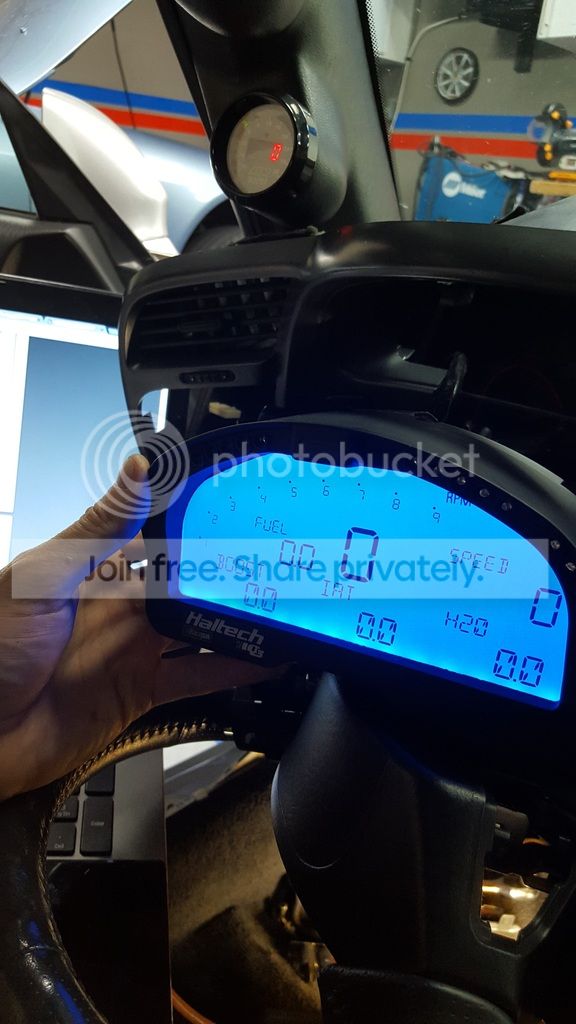
Just waiting on the adapter from Racepak so that the dash can display output from the CAN (Haltech ECU) and the VNET (Racepak USM).
DataLink software needs to first READ the calibration (from the Racepack display once the USM has been plugged in. All 4 outputs from the USM will automatically show up in the DataLink software; chose the one you used for your input (I used number 1 for my fuel level sensor signal)), then configured with the following paramaters:
^These are just the initial voltage values (exact voltages will be determined when I actually fill up the tank; these are close enough to get started though)
Next, SEND the calibration to the Racepak display after changing which parameters you want displayed on the first page (you can name the params (Channel Tag Output) whatever you'd like):
Just waiting on the adapter from Racepak so that the dash can display output from the CAN (Haltech ECU) and the VNET (Racepak USM).

Thread Starter
Joined: Mar 2005
Posts: 4,692
Likes: 6
From: Centreville, Va

Thread Starter
Joined: Mar 2005
Posts: 4,692
Likes: 6
From: Centreville, Va
Was able to get the fuel sensor output to work on the Racepak.
My little helper

The adapter cable(s)


It works! Still need to adjust the voltages a bit; very close though


Thread Starter
Joined: Mar 2005
Posts: 4,692
Likes: 6
From: Centreville, Va
Thanks Matt.
Filled the tank and measured the voltage. 1.55v with a full tank. Scaled the aforementioned table accordingly. Empty should be close to 5v, but I will measure again as soon as the tank is empty. The output is VERY sensitive. At idle or on smooth roads, the reading is stable, but cornering/accelerating/etc (basically, any time the fuel is in motion), the gauge jumps around. Oh well, it works!
Filled the tank and measured the voltage. 1.55v with a full tank. Scaled the aforementioned table accordingly. Empty should be close to 5v, but I will measure again as soon as the tank is empty. The output is VERY sensitive. At idle or on smooth roads, the reading is stable, but cornering/accelerating/etc (basically, any time the fuel is in motion), the gauge jumps around. Oh well, it works!