


Need help going from FWD to RWD


Registered User
Joined: Jul 2002
Posts: 1,918
Likes: 0
From: Ottawa

I'll start from ground zero, so bear with me.
There is essentially no driving difference in any drive configuration FWD, RWD or AWD until you get to the point of losing traction. The different drive configurations will start to lose traction (tire skid) at different times, so will behave differently. There are two basic concepts about tire traction. One, the tire with more weight on it will have more traction. Two, a tire has a limited amount of traction which can be used to brake, accelerate, turn, turn/accelerate or turn/brake. When a tire starts to skid, it will continue in a straight line.
FWD makes the front wheels responsible for braking, accelerating and turning. This typically means that the front tires are going to loose traction first and skid. This will make FWD's understeer, i.e. go straight instead of turning. To gain back control in this situation you have to reduce the gas, brake, steering angle or all of the above to get back to the tire's traction capability. Typically, people will get into a skid by going into a turn too fast. The natural reaction is to get off the gas which throws weight on the front tires and reduces the acceleration allowing the front wheels to regain traction and turn again. This is the reason why FWD is considered safer, because when you lose traction it is not that scary and a typical driver defaults into doing the right thing.
RWD makes the rear wheels responsible for acceleration and the front tires for braking and turning. The biggest difference is that there is a possiblity of the rear tires skidding before the fronts with to much acceleration. If you give too much gas in a turn and the rear tires skid first and you get oversteer, i.e. you are turning more than you expect. Essentially, the back end goes straight and you start a spin. A spin is typically more dangerous than sliding in a straight line. Ok so too much gas in a turn starts the spin. What does the typical non-RWD driver do? Lift off the gas. This is bad, weight goes forward giving even more traction to the front wheels and making the oversteer worse ... guaranteeing a spin. There is many things that you can do to get back into control. The conservative way is to LIGHTLY let off the gas (to regain rear wheel traction) and steer where you want to go. The aggressive way is to give more gas (to transfer weight back to get more traction) and steer where you want to go. Note that the car can still understeer too so the stuff in FWD section applies too.
Obviously there is more stuff, but if you understand the basic traction concepts, you can pretty much figure out the RWD vs. FWD yourself. If you really want to learn more there are a bunch of high performance driving books or even better a high performance driving school.
There is essentially no driving difference in any drive configuration FWD, RWD or AWD until you get to the point of losing traction. The different drive configurations will start to lose traction (tire skid) at different times, so will behave differently. There are two basic concepts about tire traction. One, the tire with more weight on it will have more traction. Two, a tire has a limited amount of traction which can be used to brake, accelerate, turn, turn/accelerate or turn/brake. When a tire starts to skid, it will continue in a straight line.
FWD makes the front wheels responsible for braking, accelerating and turning. This typically means that the front tires are going to loose traction first and skid. This will make FWD's understeer, i.e. go straight instead of turning. To gain back control in this situation you have to reduce the gas, brake, steering angle or all of the above to get back to the tire's traction capability. Typically, people will get into a skid by going into a turn too fast. The natural reaction is to get off the gas which throws weight on the front tires and reduces the acceleration allowing the front wheels to regain traction and turn again. This is the reason why FWD is considered safer, because when you lose traction it is not that scary and a typical driver defaults into doing the right thing.
RWD makes the rear wheels responsible for acceleration and the front tires for braking and turning. The biggest difference is that there is a possiblity of the rear tires skidding before the fronts with to much acceleration. If you give too much gas in a turn and the rear tires skid first and you get oversteer, i.e. you are turning more than you expect. Essentially, the back end goes straight and you start a spin. A spin is typically more dangerous than sliding in a straight line. Ok so too much gas in a turn starts the spin. What does the typical non-RWD driver do? Lift off the gas. This is bad, weight goes forward giving even more traction to the front wheels and making the oversteer worse ... guaranteeing a spin. There is many things that you can do to get back into control. The conservative way is to LIGHTLY let off the gas (to regain rear wheel traction) and steer where you want to go. The aggressive way is to give more gas (to transfer weight back to get more traction) and steer where you want to go. Note that the car can still understeer too so the stuff in FWD section applies too.
Obviously there is more stuff, but if you understand the basic traction concepts, you can pretty much figure out the RWD vs. FWD yourself. If you really want to learn more there are a bunch of high performance driving books or even better a high performance driving school.


Registered User
Joined: Jul 2002
Posts: 1,918
Likes: 0
From: Ottawa
This is where you have to know the difference between driving like a crazy wannabe racecar driver and driving at a reasonable rate for the conditions.
What I described above is what you do to correct a minor error. If you going into a corner that fast it doesn't matter if it is FWD, RWD, AWD, have traction control or ABS ... you are done like dinner. You can't break the law of physics. It doesn't matter about the car, THE DRIVER has to know when you are getting close to the limit. If you can take a turn on a dry warm day at 30 mph, you have to know you can't do the same speed in the rain or snow.
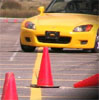
You really just have to get experience with the limits of the car. DO NOT do this on public streets. Go to an empty parking lot after a snow or rain and experiment. Do an autocross. Do a driving class. No internet forum will teach you experience, and you would need a book to cover every possible driving technique.
What I described above is what you do to correct a minor error. If you going into a corner that fast it doesn't matter if it is FWD, RWD, AWD, have traction control or ABS ... you are done like dinner. You can't break the law of physics. It doesn't matter about the car, THE DRIVER has to know when you are getting close to the limit. If you can take a turn on a dry warm day at 30 mph, you have to know you can't do the same speed in the rain or snow.
You really just have to get experience with the limits of the car. DO NOT do this on public streets. Go to an empty parking lot after a snow or rain and experiment. Do an autocross. Do a driving class. No internet forum will teach you experience, and you would need a book to cover every possible driving technique.
Joined: Sep 2003
Posts: 7,620
Likes: 1
From: Ottawa
Originally posted by Mr_Ginzo
well lets say i'm taking a turntoo fast, and have to slow down if i slam on the breaks or downshift quickly won't i lose control?
well lets say i'm taking a turntoo fast, and have to slow down if i slam on the breaks or downshift quickly won't i lose control?
I'm not expert like Fongu, but
 don't do that!
Fongu already stated it, if your going to fast you lift LIGHTLY off the trottle.
If you slam on the brakes, you may just go straight (understeer) as almost ALL your weight is transfered to the front tires when you brake, cars don't brake well while turning you usually just PLOW straight. If you downshift quickly, you better be rev matching which means you won't slow down anyways, if you downshift all your weight will be transfered forward abrutley which could be worse than slamming on the brakes are your front tires are still spinning rapidly.
You have 3 options if you go in the corner too fast.
1) lift throttle lightly
2) powerslide through the corner buy applying more power as you drift and countersteering.
3)
Hold on to your hat and hope for the best!EDIT: And as Fongu stated don't do this on public roads, if you powerslide you better hope nobody is coming down the next lane!
Trending Topics

Registered User
Joined: May 2003
Posts: 417
Likes: 0
From: Toledo
Best advice for this, as I too in '02 went got my s2k, coming from 99civ SI and other FWD.
Find a large empty parking lot, pick times where you are not likely to get bothered, and go play. Learn the limits in as safe of an environment as possible. Take a learners course at a local track. Bust out the ps2, GT3, simulation tires and go to town, it still amazes me how accurate the physics are. (Throtle lift oversteer on demand at the limits, it is a blast)
AND BY ALL MEANS JOIN SCCA AND GO AUTO-X. Hands down the most legal fun you can have in a parking lot/air strip. Not the mention the great seat time (best way to learn) and instruction you can get from vets there.
Find a large empty parking lot, pick times where you are not likely to get bothered, and go play. Learn the limits in as safe of an environment as possible. Take a learners course at a local track. Bust out the ps2, GT3, simulation tires and go to town, it still amazes me how accurate the physics are. (Throtle lift oversteer on demand at the limits, it is a blast)
AND BY ALL MEANS JOIN SCCA AND GO AUTO-X. Hands down the most legal fun you can have in a parking lot/air strip. Not the mention the great seat time (best way to learn) and instruction you can get from vets there.


Registered User
Joined: Jul 2003
Posts: 819
Likes: 0
From: Portland, OR
Originally posted by RazorV3
never, ever lift off the throttle while making a hard turn.
never, ever lift off the throttle while making a hard turn.
 . I can recall once where it saved my bacon. I was driving a twisty country two lane road that goes up and over a ridge one night here near Portland and it was raining. I was driving my first MR-2 Spyder not too long after I got it (a car more tail happy than the pre-'04 S). The sharp turns were all clearly marked with the yellow curved arrow signs (or so I thought) and I was hot footing it up the hill pretty fast. Well to make a long story short, just before the top of the hill they had been doing some construction and had taken down the curve sign on the 2nd to last turn so it surprised me and I came into it way too hot. When I realized how tight it was I instantly thought there was no way I was going to make the corner, but I cut the wheel pretty hard into the turn anyway and lifted the throttle completely fully expecting to slide sideways into the ditch. Well, the little Spyder popped it's rear end around very quickly and as it did I immediately gave it full counter lock and ended up performing an almost perfect "J" turn, straightening it up as the rear end pulled back in and headed toward the next turn with a slight bit of fishtail
  . Luckily for me the patch of road where they were doing the construction had been widened quite a bit and there was plenty of room because I was about 3/4 sideways right at the apex of the turn. I remember thinking at the time that the driver of another car that had come around the next corner headed toward me must have been wondering why my headlights were swinging back and forth across the road, and feeling a bit lucky but also happy that my quick reactions and the responsiveness of the car had kept me from trashing my new ride. I made a mental note to not push it quite so much on dark rainy nights where you can't see the turns coming up in front (and to never ever again rely on the presence of street signs...). Granted, at the time it was basically a last ditch emergency maneuver but having rethought it in my mind many times, I really think that given the pace I was going and tightness of the turn there was no other way I could have come through unscathed.
ron

Thread
Thread Starter
Forum
Replies
Last Post