When you click on links to various merchants on this site and make a purchase, this can result in this site earning a commission. Affiliate programs and affiliations include, but are not limited to, the eBay Partner Network.
With all of these "multiple-replacements" (soon to include myself... my 2nd tensioner has ~6K miles on it and is already sounding horrific)... I can't help but wonder if the root cause is something other than the TCT. Maybe the TCT "going bad" is just a side effect of a larger issue.
Everyone tells me that "timing chains don't stretch", but what if they do? That would mean that the TCT would have to be extended farther to keep the chain tight. If you know how springs work, then you know that the farther the spring in the TCT extends, the less force it's putting on the tensioner arm... therefore the more likely you would be to get rattles and other noise.
If it wasn't such a PITA to replace a timing chain, I'd replace mine just to see if that had an impact.
I doubt the timing chain is stretching, u would see alot more issues with the engine.
The tensioner is the root cause, you get an immediate fix upon replacement, but then you have to replace it every 6 months or so. Has anyone brought this issue to a dealer more than once? if so what have they said?
mine started out at start up on warm starts> now the the noise lasts longer after i had a valve adjustment and retainer inspection done at the dealer. Car sounds load while im driving as well sometimes. I had vtec bog a few times so i checked the vtec solinoid last night and she was clean a whistle. I think the bog might be from washing the car with the aem ver2 intake getting wet. im ordering a new tensioner tomorrow.
Did the install this afternoon. The job would only have taken me about 15 minutes if I did not document and take pics of the procedure. Make sure you do this on a cool engine.
After running the car for a while with the new tensioner in I noticed the the car is a lot quieter at idle. For the past couple of years I just attributed the noisy valve train of my S to that. I thought I just had a noisy one. It sounded like a diesel at idle sometimes or sounded like the valves were out of adjustment no matter how many times they were checked. Hardtopguy had also done a valve adjustment a couple times and I checked the clearances a month ago and all was good. I still have some valvetrain noise, but all S2000's do. I have not driven the car to get it nice and hot and restart it 10 minutes later to see if the really bad noise is gone (cards in bicycle wheel spokes sound) but since the car is so much quieter, the tensioner was probably weak for the past couple of years and just finally started to really fail as of late. To my knowledge, there is no way to test the tensioner installed in the car.
Here is what you will be looking at to replace the TIMING CHAIN AUTO TENSIONER. We will not be compressing the tensioner piston since we are doing a replacement. I will practice with that at a later date.
Tools needed:
T-50 hex
10 mm socket
Ratchet and short extension
Long tip/nose pliers
The tensioner is located under the vtec solenoid/valve on the front passenger side of the head.
A look at the bolts and the maintenance hole. (the larger brass bolt on the bottom left in the photo is not a tensioner bolt) You will see where the tensioner bolts are when you look at the new one.
Now remove the two bolts that hold the tensioner and the maintenance bolt. The maintenance bolt is a T-50 hex and the the others are 10mm. They are not tight.
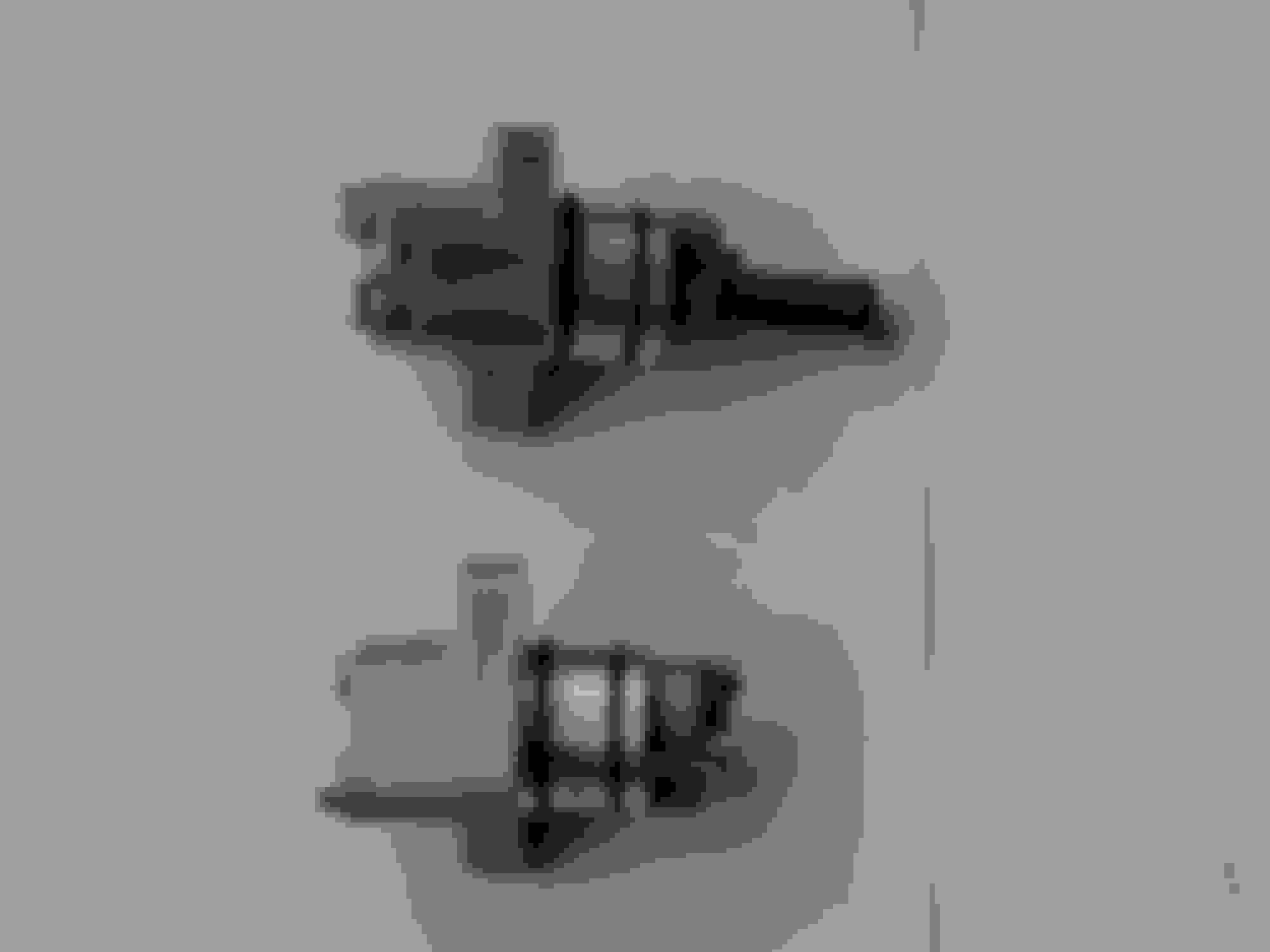
Now remove the tensioner. It may take some rotation of the tensioner while pulling it out. Very little oil will come out, but there will be a good amount of leakage from the old tensioner since it works by oil pressure. Also, do not point the old tensioner down or the piston will fall out. The tensioner on top is the old one. As you can see, the piston has a lot of travel.
Now insert the new tensioner in the head and bolt it in place. The bolts do not need to be super tight. to helms only calls for 8.7 pound of torque. Make sure the set pin is facing the maintenance hole and the bend on the set pin is facing east so it sort of looks like this l__ If it is facing this way __l it is difficult to remove through the maintenance hole. Grab the set pin and pull it out a little at first then get a better grip on it and pull it all the way out. You will hear a "pop" when the piston extends. Do not drop the set pin within the engine. Who knows what damage that would do.
View of tensioner through maintenance hole.
Removal of set pin.
Looking at the old tensioner I noticed a flaw by one of the o-rings that the new one does not have. This may or may not contribute to a loss of oil pressure within the tensioner but there is no way to check that. If it does let the pressure drop, this could have partially been part of the problem. The tensioner would not have full internal oil pressure letting the chain have some slack making noise against the chain guides, but this is only a theory. The old tensioner is probably just plain old bad.
This is helpfull. Good job!
Is it safer to take it out with piston retracted so it dosn't fall or are you causing more risk like it might fall in while your doing it. If so how do you go about doing that.
This is helpfull. Good job!
Is it safer to take it out with piston retracted so it dosn't fall or are you causing more risk like it might fall in while your doing it. If so how do you go about doing that.
You do not need to retract the piston. The assembly is at an angle so I do not see the piston falling in. But, when you have the tensioner out and you anle it down, the piston will fall on the ground with the spring.
I don't know if there is actually a risk of the piston falling into the engine, but the Helm's manual specifically states to retract the piston and lock it into place before removing the tensioner.
The procedure includes:
1) Remove the plate on the back of the tensioner (two bolts visible in the picture below).
2) Remove the screw that is revealed.
3) Thread a nut onto a bolt (can't remember the size of the bolt needed, check Helms).
4) Thread the bolt into the hole (which was uncovered by the plate), and turn it to retract the piston.
5) When the piston is retracted, use the nut to 'secure' the bolt and lock it into place so it doesn't turn (which would allow the piston to extend).