


Breaking 15psi





Joined: Mar 2003
Posts: 6,507
Likes: 51
From: Sellersburg, IN

Originally Posted by jbotstein1,Oct 6 2006, 03:27 PM
I would also like to know what Spoolin is asking. Maybe I can ask it more clearly. I am running 11 psi on 9:1 Comp pistons and I make about 370 whp. Now someone running 7-8psi can also make 370 whp at 11:1 compression. What is the advantage of running the lower compression ratio in this situation? I did it for the added safety, althoug my engine is a bit overkill for my setup. Spoolin, is that what you were asking?
Although, why is your engine safer if your overall CR on a 9:1 engine is say 16.5:1 under 11 psi of boost and making 370 whp and an engine with 11:1 CR is at say 16.5:1 under 7 psi of boost and making the same 370 whp? This is what makes no since. The 11:1 engine will always have more TQ. If the safety factor is the same because both engines yield the same overall CR under boost and make the same power; then why bother putting on a HG or building the motor for a lower CR? Can you get the same power out of an 11:1 CR motor on 10 psi of boost as you can on the same motor with 9:1 CR and 15 psi of boost if both indeed yield the exact same overall CR of 18.5:1 under boost?
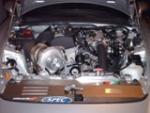
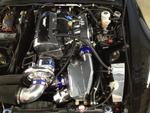
I am trying to figure this out because my turbo is custom built for the S2000 and it's engine, it was designed to run at 8 psi on a 2.0 liter engine that revs to 9000 rpm, but it can also run all the way to 22 psi.


Joined: Oct 2000
Posts: 9,033
Likes: 21
From: South of the pier, Huntington Beach, CA
Originally Posted by Spoolin,Oct 6 2006, 09:30 AM
That doesn't explain what I needed to know.
10 psi on 11:1 CR is 18.5:1 total compression under boost and 15 psi on 9:1 CR with the 3mm HG is 18.2:1 total compression under boost.
Why is it not safe and what's the difference if the end result in total boosted CR is the same between the two?
10 psi on 11:1 CR is 18.5:1 total compression under boost and 15 psi on 9:1 CR with the 3mm HG is 18.2:1 total compression under boost.
Why is it not safe and what's the difference if the end result in total boosted CR is the same between the two?
High Compression Ratio (CR) will cause increased detonation relative to low CR.
The lower CR combustion chamber will have more volume at top dead center. This larger volume allows more fuel/air mixture to be present when ignition takes place.
As boost increases the amount of fuel/air increases and thus power.
The higher CR combustion chamber has less volume at top dead center. The total amount of fuel/air is squeezed smaller and tighter. This puts more stress on the connecting rod and is one of the reasons we upgrade the rods when rebuilding.
The other main reason for upgrading the rods is to make the rodbolts stronger for more rpms safely.
The end result with adding a 2 or 3 mm headgasket to a stock engine is less stress on the rods, less detonation, and more fuel/air mixture available for increased power output.
With the low compression, where you are not boosting major numbers you will be seeing less power. It's not a lot less power and the lower compression certainly makes up for it when you are boosting major numbers.
The rod loads go up when the boost goes up so there are limits on the factory rods even with a 3mm head gasket.
An interesting side note, Top fuel dragsters compress so much fuel so hard it is virtually a solid when ignition takes place.


Joined: Mar 2003
Posts: 1,343
Likes: 0
Wow. That's pretty cool. I remember in Chemistry the chart that related pressure, temperature, and state ofmatter. That's a lot of pressure to turn a liquid into a solid at such a high temperature! Spoolin, I think what Sideways said is our answer. I don't know much about this stuff, but everyone seems to say that a lower CR decreases your risk of detonation. And like I said, my setup is probably overkill considering I only run 11psi daily, but it makes me feel better that nothing should break.

Registered User
Joined: Dec 2005
Posts: 79
Likes: 1
From: Toronto
Originally Posted by Spoolin,Oct 6 2006, 05:52 PM
Yes, that is basically what I am saying.
Although, why is your engine safer if your overall CR on a 9:1 engine is say 16.5:1 under 11 psi of boost and making 370 whp and an engine with 11:1 CR is at say 16.5:1 under 7 psi of boost and making the same 370 whp? This is what makes no since. The 11:1 engine will always have more TQ. If the safety factor is the same because both engines yield the same overall CR under boost and make the same power; then why bother putting on a HG or building the motor for a lower CR? Can you get the same power out of an 11:1 CR motor on 10 psi of boost as you can on the same motor with 9:1 CR and 15 psi of boost if both indeed yield the exact same overall CR of 18.5:1 under boost?
I am trying to figure this out because my turbo is custom built for the S2000 and it's engine, it was designed to run at 8 psi on a 2.0 liter engine that revs to 9000 rpm, but it can also run all the way to 22 psi.
Although, why is your engine safer if your overall CR on a 9:1 engine is say 16.5:1 under 11 psi of boost and making 370 whp and an engine with 11:1 CR is at say 16.5:1 under 7 psi of boost and making the same 370 whp? This is what makes no since. The 11:1 engine will always have more TQ. If the safety factor is the same because both engines yield the same overall CR under boost and make the same power; then why bother putting on a HG or building the motor for a lower CR? Can you get the same power out of an 11:1 CR motor on 10 psi of boost as you can on the same motor with 9:1 CR and 15 psi of boost if both indeed yield the exact same overall CR of 18.5:1 under boost?
I am trying to figure this out because my turbo is custom built for the S2000 and it's engine, it was designed to run at 8 psi on a 2.0 liter engine that revs to 9000 rpm, but it can also run all the way to 22 psi.
Running higher boost lower compression gives you more power by virtue of physically forcing more air fuel mixture into your engine to be combusted. Running lower boost with higher compression puts less air fuel into the engine, however due to the greater thermodynamic efficiency of higher compression ratios, more power is extracted from the fuel that is there.
Running lower boost higher compression may be more fuel efficient for a given power output and will give you more torque off boost. Running higher boost lower compression is less prone to detonation and allows you to be more aggressive with your tune (i.e. leaner a/f, more ignition advance) which may give you more power if properly tuned.
Additionally, the turbo you are you using affects what boost compression combination you should run. Although your turbo is good for between 8 and 22 psi, there is some optimal boost level between those two extremes where your turbo is operating most efficiently (i.e. where the air is heated the least for a given psi of boost under the ideal gas law a.k.a. the point closest to the centre of your turbo's compressor map). This should be your selected boost level and your compression ratio selected as the maximum possible without experiencing detonation.
That's what they do in professional racing, where boost level is dictated by the rules and compression ratio & turbo sizing is optimized around that boost level.
Joined: Mar 2003
Posts: 6,507
Likes: 51
From: Sellersburg, IN
Originally Posted by LUVNMBRS,Oct 9 2006, 01:07 PM
Although my S2K is not turbocharged, I've read about this topic in books written for other turbo Hondas. So here goes:
Running higher boost lower compression gives you more power by virtue of physically forcing more air fuel mixture into your engine to be combusted. Running lower boost with higher compression puts less air fuel into the engine, however due to the greater thermodynamic efficiency of higher compression ratios, more power is extracted from the fuel that is there.
Running lower boost higher compression may be more fuel efficient for a given power output and will give you more torque off boost. Running higher boost lower compression is less prone to detonation and allows you to be more aggressive with your tune (i.e. leaner a/f, more ignition advance) which may give you more power if properly tuned.
Additionally, the turbo you are you using affects what boost compression combination you should run. Although your turbo is good for between 8 and 22 psi, there is some optimal boost level between those two extremes where your turbo is operating most efficiently (i.e. where the air is heated the least for a given psi of boost under the ideal gas law a.k.a. the point closest to the centre of your turbo's compressor map). This should be your selected boost level and your compression ratio selected as the maximum possible without experiencing detonation.
That's what they do in professional racing, where boost level is dictated by the rules and compression ratio & turbo sizing is optimized around that boost level.
Running higher boost lower compression gives you more power by virtue of physically forcing more air fuel mixture into your engine to be combusted. Running lower boost with higher compression puts less air fuel into the engine, however due to the greater thermodynamic efficiency of higher compression ratios, more power is extracted from the fuel that is there.
Running lower boost higher compression may be more fuel efficient for a given power output and will give you more torque off boost. Running higher boost lower compression is less prone to detonation and allows you to be more aggressive with your tune (i.e. leaner a/f, more ignition advance) which may give you more power if properly tuned.
Additionally, the turbo you are you using affects what boost compression combination you should run. Although your turbo is good for between 8 and 22 psi, there is some optimal boost level between those two extremes where your turbo is operating most efficiently (i.e. where the air is heated the least for a given psi of boost under the ideal gas law a.k.a. the point closest to the centre of your turbo's compressor map). This should be your selected boost level and your compression ratio selected as the maximum possible without experiencing detonation.
That's what they do in professional racing, where boost level is dictated by the rules and compression ratio & turbo sizing is optimized around that boost level.

Registered User
Joined: Dec 2005
Posts: 79
Likes: 1
From: Toronto
No problem. Just to elaborate on what others have already said in this thread...I think running 10 psi on 11:1 compression, you'll be on the ragged edge of detonation. All you need is a tank of bad gas, a really hot day, a clogged injector, etc. and BANG...say goodbye to your expensive engine.
However, running 15 psi at 8.9:1, you'll still have plenty of safety margin left over, as evidenced by the people boosting 20 psi with a 3mm HG...that gives you a 5 psi safety cushion! This boost compression combination also seems consistent with factory turbo cars such as the STi (14 psi at 8.0:1) and the Evo (18 psi at 8.8:1). IMHO, this is the better way to go to reach your goals.
If you are risk tolerant enough to run 10 psi at 11:1, then you might as well run 20 psi at 8.9:1, as you'll be taking the same level of risk, but getting a higher horsepower return for it.
Btw, here's a link to the book I'm getting some of this info. from:
http://search.barnesandnoble.com/booksearc...557883841&itm=1
The author is a professional engineer whose worked for Nissan, however he writes at a level in which non-engineer types can fully understand. Although most of it is written for the Honda B series engines, I think it is entirely applicable to the F20C. This is one of the best books I've ever read and it has greatly improved my knowledge. It's well worth the $18 cost and I highly recommend it! Hope this helps.
However, running 15 psi at 8.9:1, you'll still have plenty of safety margin left over, as evidenced by the people boosting 20 psi with a 3mm HG...that gives you a 5 psi safety cushion! This boost compression combination also seems consistent with factory turbo cars such as the STi (14 psi at 8.0:1) and the Evo (18 psi at 8.8:1). IMHO, this is the better way to go to reach your goals.
If you are risk tolerant enough to run 10 psi at 11:1, then you might as well run 20 psi at 8.9:1, as you'll be taking the same level of risk, but getting a higher horsepower return for it.
Btw, here's a link to the book I'm getting some of this info. from:
http://search.barnesandnoble.com/booksearc...557883841&itm=1
The author is a professional engineer whose worked for Nissan, however he writes at a level in which non-engineer types can fully understand. Although most of it is written for the Honda B series engines, I think it is entirely applicable to the F20C. This is one of the best books I've ever read and it has greatly improved my knowledge. It's well worth the $18 cost and I highly recommend it! Hope this helps.
Joined: Mar 2003
Posts: 6,507
Likes: 51
From: Sellersburg, IN
I'll check it out, thanks.
BTW, I just got a retune on 9.8 psi of boost and am making 397 whp/258 lbft of tq. My tuner is very well known and works for AEM and tunes NOPI cars and he told me that 10 psi will be fine and he will make it safe. We stuck with 9.8 psi because he thought it would be safer since the stock MAP sensor starts breaking up just past 10 psi.
BTW, I just got a retune on 9.8 psi of boost and am making 397 whp/258 lbft of tq. My tuner is very well known and works for AEM and tunes NOPI cars and he told me that 10 psi will be fine and he will make it safe. We stuck with 9.8 psi because he thought it would be safer since the stock MAP sensor starts breaking up just past 10 psi.

Thread
Thread Starter
Forum
Replies
Last Post
timg
Forced Induction For Sale
3
Sep 18, 2012 02:46 AM
Reborn56
S2000 Forced Induction
3
Feb 12, 2007 03:22 PM

