


KW V3 Tuning Guide

Registered User
Joined: Sep 2008
Posts: 2,380
Likes: 0
From: Arizona

What would need clarified is "increase rebound dampening".
Normally, Increasing rebound +, decreases the speed/force exerted downward.
they might actually mean to lower you rebound setting to increase that force.
weight transferring at a slower rate from front to rear isn't going to make a big difference on front grip on corner exit but likely works with transitional traction IMO.
Sent from my Galaxy Nexus using Tapatalk 2
Normally, Increasing rebound +, decreases the speed/force exerted downward.
they might actually mean to lower you rebound setting to increase that force.
weight transferring at a slower rate from front to rear isn't going to make a big difference on front grip on corner exit but likely works with transitional traction IMO.
Sent from my Galaxy Nexus using Tapatalk 2
Thread Starter
Former Moderator


Joined: Jul 2005
Posts: 4,634
Likes: 28
From: West Virginia
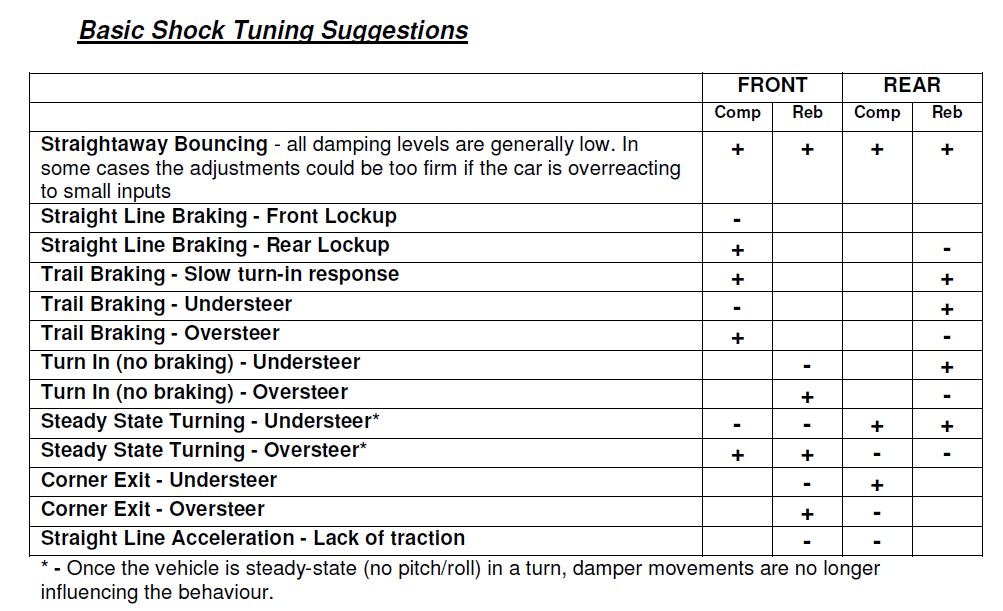
Can you clarify this? It *seems* your understeer suggestion may be at odds with the diagram. What am I missing?

Registered User
Joined: Sep 2008
Posts: 2,380
Likes: 0
From: Arizona
just taking a quick read through the fine points of penske's tech manual here makes me want 3 ways after I'm tired of these clubsports
http://www.penskeshocks.co.uk/downlo...TechManual.pdf
http://www.penskeshocks.co.uk/downlo...TechManual.pdf

Registered User
Joined: Oct 2011
Posts: 178
Likes: 0
From: North Carolina
I recognize that shock adjustment isn't something that happens in a vacuum isolated from other aspects of setup. But at an event if the surface is more or less grippy than expected one typically has only tire pressures and shock adjustments as variables while sitting in grid.
I appreciate your opinion, and apologize that this may have gotten a bit offtopic!


Joined: Sep 2006
Posts: 4,762
Likes: 3
From: San Diego
My track settings for BW:
Compression F: 2 from full stiff
Rebound F: 2 from full Stiff
Compression R: 2 from full stiff
Rebound R: 4 from full stiff
At SOW: Raise F Rebound to 1 from full stiff.
Notes: Nonstaggered w/255x4, non-aero.
Compression F: 2 from full stiff
Rebound F: 2 from full Stiff
Compression R: 2 from full stiff
Rebound R: 4 from full stiff
At SOW: Raise F Rebound to 1 from full stiff.
Notes: Nonstaggered w/255x4, non-aero.
Thread Starter
Former Moderator
Joined: Jul 2005
Posts: 4,634
Likes: 28
From: West Virginia
Antonov, thanks for sharing your setup, what spring rates, anti-roll bars and camber settings are you running?
Thread Starter
Former Moderator
Joined: Jul 2005
Posts: 4,634
Likes: 28
From: West Virginia
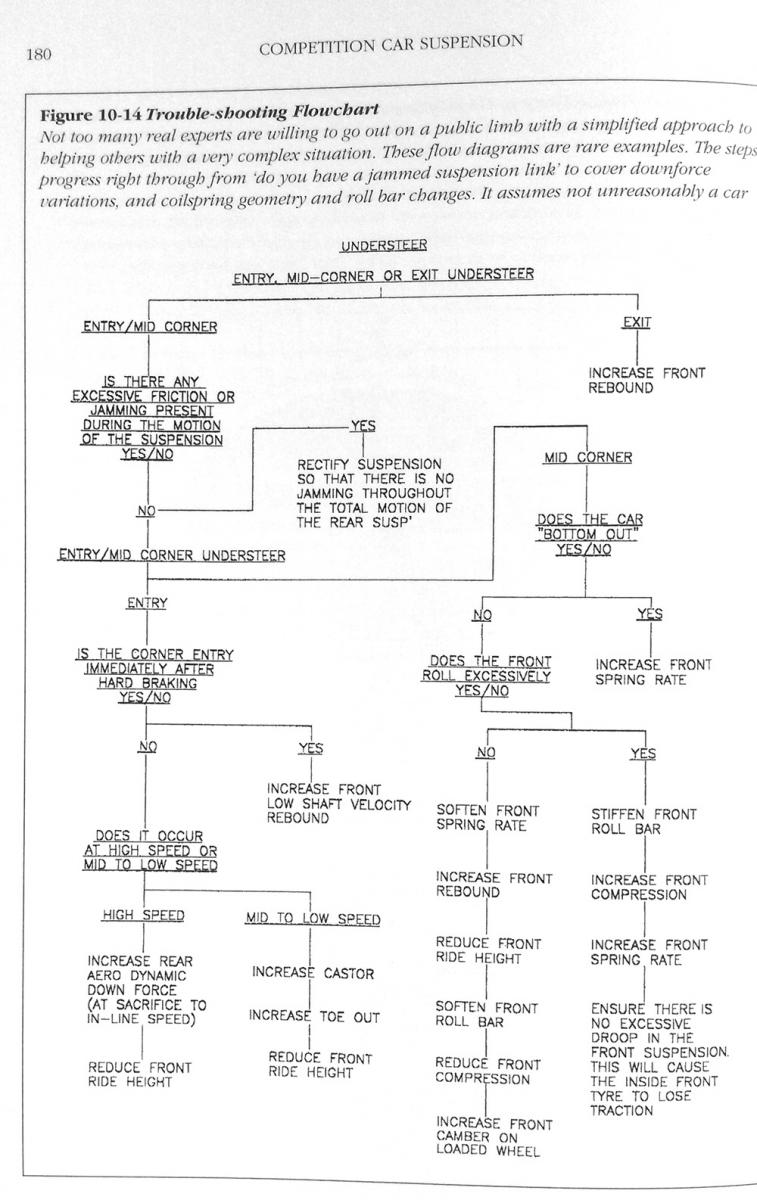
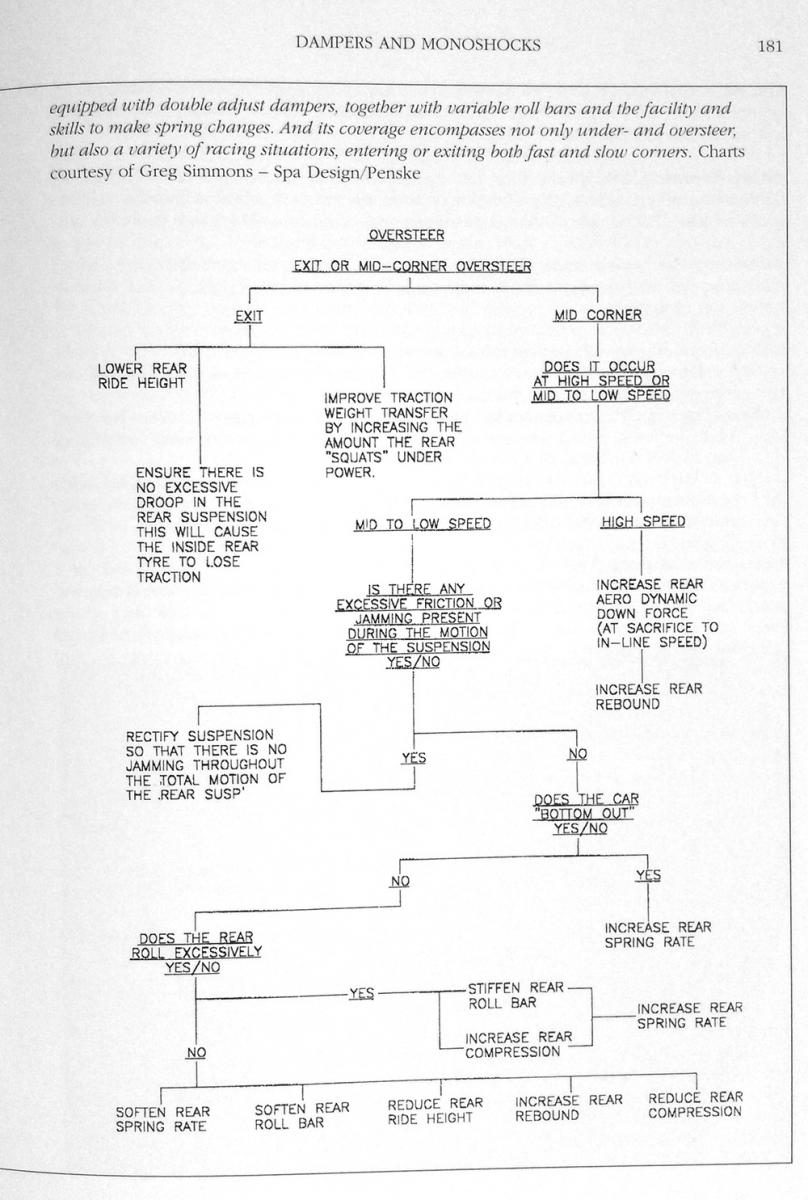
for example? If it does help, the Sachs reference suggests softening/decreasing the front (rebound and compression) and stiffening the rear. The Staniforth/Simmons flowchart says nothing about rear adjustment, but suggests stiffening front rebound. . . Those two recommendations seem to me to be in conflict.
I don't see how stiffening front rebound would help with mid corner understeer.
Again with oversteer recommendations: Sachs guide says stiffen the front, soften the rear while Staniforth/Simmons says increase/stiffen rear rebound, decrease/soften rear compression (among other things) and makes no mention about adjusting the front.
The Sachs guide makes sense to my non-suspension engineer brain here.
Third, the Sach's guide says to soften front rebound with corner exit understeer, while Staniforth says to increase/stiffen front rebound.
The Staniforth graph makes more sense here. Normally adjusting rebound at the opposite end of the car is done to change the rate of weight transfer. Adjusting the compression and rebound on the same axle is done to affect traction. I believe this probably accounts for some of the discrepancies between the two shock tuning guides. I did some searching and found Allen Staniforth's understeer and oversteer guides from his book and I'll put them up on the web page.
Joined: Feb 2001
Posts: 1,045
Likes: 1
From: Chicago
I don't see how stiffening front rebound would help with mid corner understeer.

Registered User
Joined: Sep 2008
Posts: 4,926
Likes: 0
For BW: I use:
2 off full stiff compression
4 off full stiff rebound
2 off full stiff rear compression
7 off full stiff rear rebound
Sway bars: Eibach front, OEM 05 rear. Spring rates are standard KW CS springs. I believe 571lbs all around, on street tire.
Registered User
Joined: Oct 2011
Posts: 178
Likes: 0
From: North Carolina
Thanks for adding those charts, Rob. The MCoupe one I linked is a direct copy of that--the companion MCoupe oversteer alogrithm has an error in it, so if anyone sees that floating around please take note and follow the Staniforth ones posted here...Interesting point about the Sachs being more Mustang-specific given its different suspension setup, power differences etc.
Clark, thanks for that clarification. That is what I experienced in my car (along with some exit understeer) and confirmed that increasing front rebound stiffness helped that go away--hence my confusion with the Sach's recommendation. Clearly, autocross turns are sharper, shorter in both length and duration to roadrace/track turns, so there's probably some nuance that gets lost in translation as both of those charts are for track use.
I should also edit my comment about the Staniforth guide not mentioning front adjustments to handle exit oversteer. I assume that the comment "Improve traction weight transfer by increasing the amount the rear 'squats' under power" in the flowchart to mean that one can stiffen front bar, soften front rebound in an effort to promote better/faster rearward weight transfer to keep the rear tires in contact. That seems to flow well with your concept, Rob, about adjusting the opposite "axle" to affect rate of weight transfer.
Clark, thanks for that clarification. That is what I experienced in my car (along with some exit understeer) and confirmed that increasing front rebound stiffness helped that go away--hence my confusion with the Sach's recommendation. Clearly, autocross turns are sharper, shorter in both length and duration to roadrace/track turns, so there's probably some nuance that gets lost in translation as both of those charts are for track use.
I should also edit my comment about the Staniforth guide not mentioning front adjustments to handle exit oversteer. I assume that the comment "Improve traction weight transfer by increasing the amount the rear 'squats' under power" in the flowchart to mean that one can stiffen front bar, soften front rebound in an effort to promote better/faster rearward weight transfer to keep the rear tires in contact. That seems to flow well with your concept, Rob, about adjusting the opposite "axle" to affect rate of weight transfer.