When you click on links to various merchants on this site and make a purchase, this can result in this site earning a commission. Affiliate programs and affiliations include, but are not limited to, the eBay Partner Network.
I've never done a wet compression test. Do you just dump a little oil down each spark plug hole?
Yes
Id opt for the leak down again though first. See if you can pinpoint where the air is escaping, from either the crankcase/front breather or the intake or exhaust valves, or everything.
So I learned an important lesson here. When doing a leak down test, only remove the spark plug from the cylinder you're testing. I use Rob Robinette's site for a lot of DIY instructions, and he says to remove all plugs for a leak down test: https://robrobinette.com/S2000Compre...Leak_Down_Test Maybe that's fine on an engine that is healthy, but in my case it didn't work properly. There is so much blow by that the pressure leaks down past the rings and back up past the rings in the other bad cylinders.
Thanks to @s2000Junky for the suggestions. On cylinders 1, 2, and 3, there is massive blow by, air rushing out the valve cover vent, PCV, dipstick tube, and oil cap. Also, I could hear a little air coming out the exhaust on all 3 of those cylinders. Cylinder 4, which has good compression and leak down, has almost no air escaping anywhere. I wish they were all like cylinder 4
Here are a couple videos of how bad the leak down is:
FRM liners and rings seat different then iron sleeves, so you need everything filled. This is what my thread below is all about crankcaseleaks, affecting pressure and seating against the FRM liner
FRM liners and rings seat different then iron sleeves, so you need everything filled. This is what my thread below is all about crankcaseleaks, affecting pressure and seating against the FRM liner
If you are hearing air escaping the exhaust, its either valbe lash, bent valves, or bad/burnt seats/valves.
Thanks @Deckoz I just read through your whole thread. It seems so odd that crank case pressure leaks would cause oil consumption and poor compression, but I guess it does make sense. I have all new valve cover gaskets and spark plug hole seals, yet to be installed (was going to wait until after I get the valve cover powder coated, it looks like shit). There are spots where the valve cover is leaking, and I'm sure my oil filler cap gasket is hard too. I'm thinking I should replace every seal and O-ring that is related to crank case pressure, then check compression and leak down again.
So I learned an important lesson here. When doing a leak down test, only remove the spark plug from the cylinder you're testing. I use Rob Robinette's site for a lot of DIY instructions, and he says to remove all plugs for a leak down test: https://robrobinette.com/S2000Compre...Leak_Down_Test Maybe that's fine on an engine that is healthy, but in my case it didn't work properly. There is so much blow by that the pressure leaks down past the rings and back up past the rings in the other bad cylinders.
Thanks to @s2000Junky for the suggestions. On cylinders 1, 2, and 3, there is massive blow by, air rushing out the valve cover vent, PCV, dipstick tube, and oil cap. Also, I could hear a little air coming out the exhaust on all 3 of those cylinders. Cylinder 4, which has good compression and leak down, has almost no air escaping anywhere. I wish they were all like cylinder 4
Well, glad I could help you pinpoint the culprit, just wish you had more favorable results.
You likely may want to hold off on the turbo project for now, continue to run the car NA and let things soak in, figure out how you wan tot move forward, save more money etc. Ive been in your situation with this car over the last 15 years more times then I care to think about.
It would be one thing if it was just valve/head related, but we are looking at cylinder failure here, which is a whole different magnitude of consideration.
Last edited by s2000Junky; Feb 23, 2019 at 01:03 PM.
Well, glad I could help you pinpoint the culprit, just wish you had more favorable results.
You likely may want to hold off on the turbo project for now, continue to run the car NA and let things soak in, figure out how you wan tot move forward, save more money etc. Ive been in your situation with this car over the last 15 years more times then I care to think about.
It would be one thing if it was just valve/head related, but we are looking at cylinder failure here, which is a whole different magnitude of consideration.
Right, thats what is so annoying about this. It's my fault for not really investigating sooner, but winter is a very busy time for me.
I've been reading some stuff about the Mahle Pistons that are compatible with our FRM lined cylinders. Thinking I might pull the head off and measure the cylinder bores, then make a decision on what to do from there. Wondering if I could get away with honing the cylinders, then installing new Mahle pistons/rings. Or if the pistons are fine, just throw in some new Honda rings? I'll have the head rebuilt while its off also.
I've been reading some stuff about the Mahle Pistons that are compatible with our FRM lined cylinders. Thinking I might pull the head off and measure the cylinder bores, then make a decision on what to do from there. Wondering if I could get away with honing the cylinders, then installing new Mahle pistons/rings. Or if the pistons are fine, just throw in some new Honda rings? I'll have the head rebuilt while its off also.
Sounds like a good starting place/plan. Inspect and measure the bores, make sure they arent ovalized, see where your at for a hone and rings, and pistons if required.
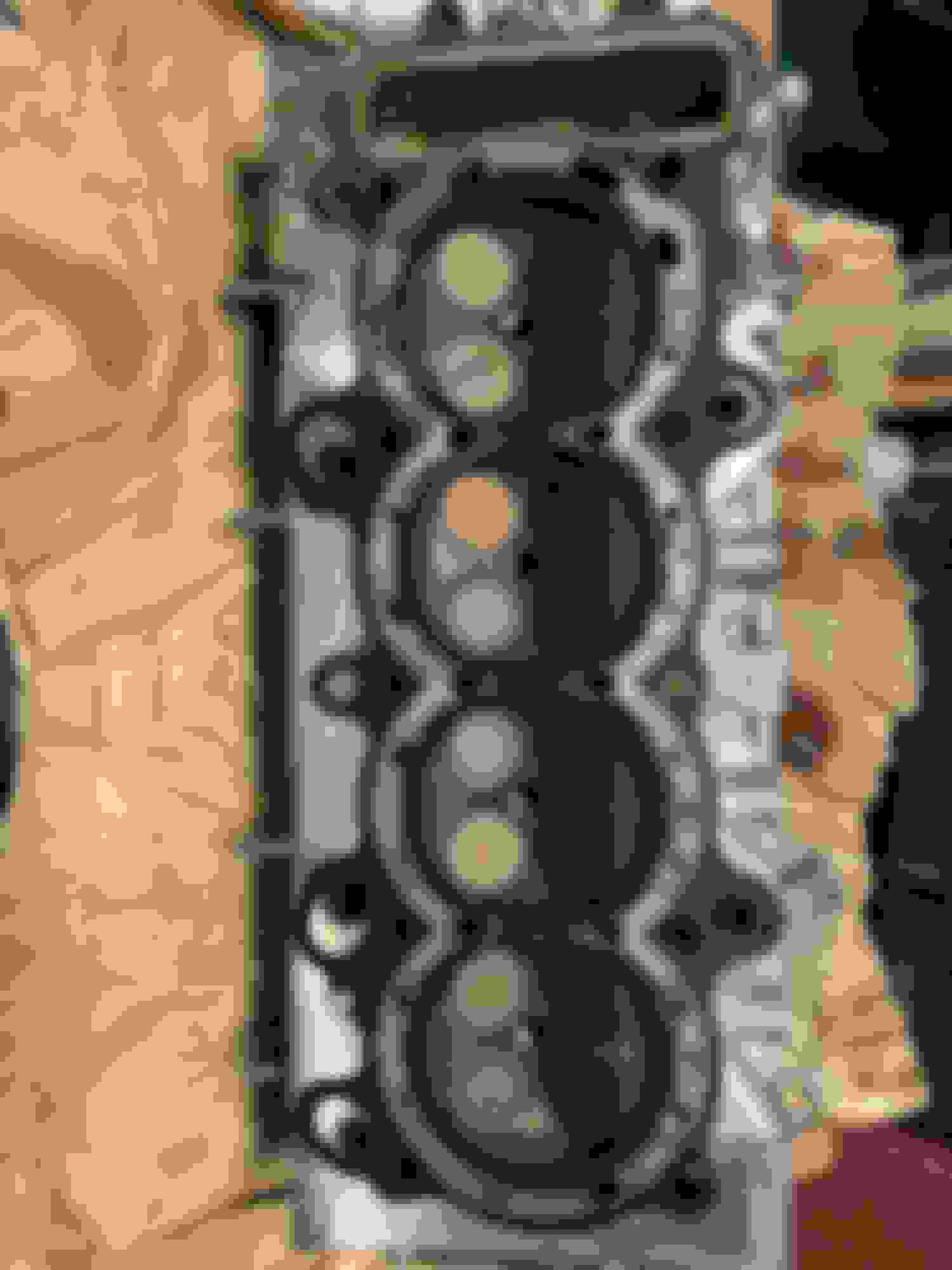
Pulled the head off this weekend and took some pics. Found something interesting that maybe will help tell me if my issues are more valve related than ring related. Intake valves, runners, combustion chambers, all have tons of carbon build up on them. Some of the exhaust valves are different colors than the others. The lighter colored exhaust valves are all the exact same ones that were extremely tight when I adjusted the valves last fall. Look at the pic and look at the clearances I recorded. Could my main problem be burnt valves? Cylinder 1 had the worst compression, cylinder 4 was the best.
Exhaust valve clearances before valve adjustment (my smallest feeler gauge is .005):