


S2000 STR prep resource


Registered User
Joined: Jun 2009
Posts: 4,340
Likes: 0
From: Frankfort, KY

Chris and mark what did you all do as for shock setting? I realize you prolly don't have a shock dyno of your exact shock setting but you could answer if you have more compression in the front or rear and if you have more rebound in the front or rear?
Thanks!
I've ran as little as 30psi with the kooks on a slick lot in the rain. Ultimately the car had more grip at that pressure for that lot but the tires felt mushy and transitioned/reacted slower. Some one within the last 10-15 pages did a test on a skidpad maybe random1 or someone saying that after data logging running 36f/34r was .5 seconds faster then any other pressure he tried. Granted this is "set-up dependent and surface dependent" but it give you a very good ballpark of where pressures should be.
Lower pressures seem to have a wider slip angle but most likely slower then having then in the 34-37 range. I set them at 36f/34r and look at how far they roll over. It always right at the point of the triangle on the wear indicator.
Thanks!
I've ran as little as 30psi with the kooks on a slick lot in the rain. Ultimately the car had more grip at that pressure for that lot but the tires felt mushy and transitioned/reacted slower. Some one within the last 10-15 pages did a test on a skidpad maybe random1 or someone saying that after data logging running 36f/34r was .5 seconds faster then any other pressure he tried. Granted this is "set-up dependent and surface dependent" but it give you a very good ballpark of where pressures should be.
Lower pressures seem to have a wider slip angle but most likely slower then having then in the 34-37 range. I set them at 36f/34r and look at how far they roll over. It always right at the point of the triangle on the wear indicator.

Registered User
Joined: Sep 2005
Posts: 1,866
Likes: 2
Originally Posted by macr88' timestamp='1315429074' post='20951846
[quote name='glagola1' timestamp='1315419153' post='20951247']
Jon, keep in mind that the Ohlins probably don't have nearly as much low speed compression as the Motons do so that could explain away some of the dive you've never noticed.
Jon, keep in mind that the Ohlins probably don't have nearly as much low speed compression as the Motons do so that could explain away some of the dive you've never noticed.
[/quote]
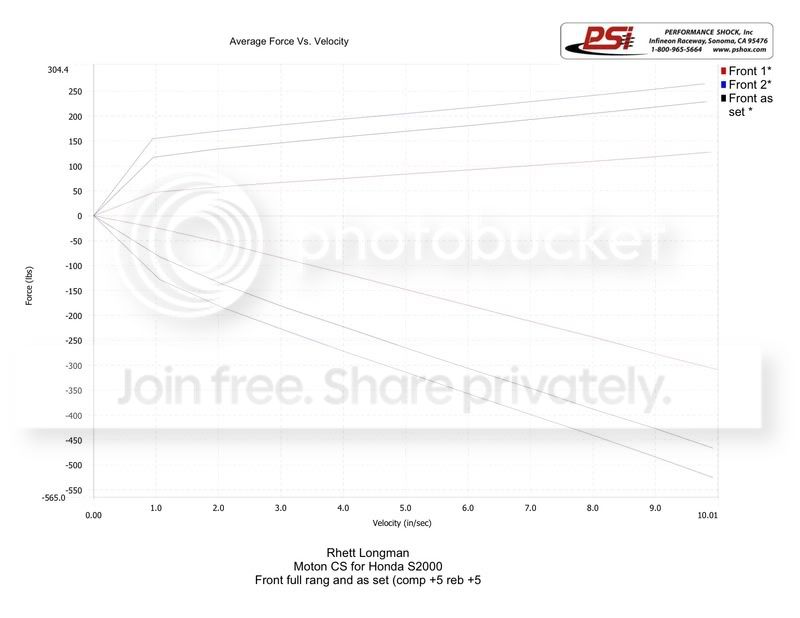
I don't have the dynos of them at full stiff, but here they are at a medium setting.




Registered User

Joined: Apr 2009
Posts: 369
Likes: 0
So while I am still practicing reading shock dynos it would appear that the Moton is creating more low speed compression because the compression stroke on the Ohlins graph is represented by the lower of the two "Vs"
referencing this DG Secrets
I wish I had some none avg. plots, but alas that is the downside of buying used and being in a hurry to get them installed.
referencing this DG Secrets
I wish I had some none avg. plots, but alas that is the downside of buying used and being in a hurry to get them installed.

Former Moderator
Joined: May 2006
Posts: 14,847
Likes: 10
From: Emmett
So while I am still practicing reading shock dynos it would appear that the Moton is creating more low speed compression because the compression stroke on the Ohlins graph is represented by the lower of the two "Vs"
referencing this DG Secrets
I wish I had some none avg. plots, but alas that is the downside of buying used and being in a hurry to get them installed.
referencing this DG Secrets
I wish I had some none avg. plots, but alas that is the downside of buying used and being in a hurry to get them installed.
Registered User
Joined: Apr 2009
Posts: 369
Likes: 0
I absolutely don't doubt that the Ohlins is a quality shock that can provide excellent chassis control. They may just do it in a different way then the Moton does. I do not fully understand shock builds, but my primary understanding is that the Moton is relatively unique in its large shaft/piston that can create large forces in a short period of time. I also know my Moton valving is relatively tame in compression to many others I have seen, but am not at liberty to share.
The advantage of this in my setup seems to be that I can use shock forces to deal with the looseness on entry without having to modify spring rates to deal with this phase of the corner instead focusing on steady state.
Also in transitions, the car seems very quick to react and take a set compared to other cars I have ridden in or driven. Other's comments when driving my car compared to S2000s on other shocks always mention this as well.
The advantage of this in my setup seems to be that I can use shock forces to deal with the looseness on entry without having to modify spring rates to deal with this phase of the corner instead focusing on steady state.
Also in transitions, the car seems very quick to react and take a set compared to other cars I have ridden in or driven. Other's comments when driving my car compared to S2000s on other shocks always mention this as well.
Registered User
Joined: Apr 2009
Posts: 369
Likes: 0
Yeah, I was just trying to get the discussion back to reference the nose diving issues discussed a page back, and why the Motons may be why he has never noticed. It is so easy for shock talks to go off on a million different but still useful tangents.
On a different note I was really glad to see the MR2 Spyder perform so well on day 2. More class diversity will keep things interesting.
On a different note I was really glad to see the MR2 Spyder perform so well on day 2. More class diversity will keep things interesting.

Joined: May 2004
Posts: 1,531
Likes: 3
From: Tucson
My setup is now in the spread sheet that 762 created. I encourage everyone else to do the same.
On R-S3 tire pressure I used to run 38F/36R. Based on skid pad testing the temperature in the center of the tread was elevated compared to the outside and inside edges. I reduced pressure 2 lbs all the way around and achieved event temps across the tread and went about 0.5 seconds faster around a skid pad with 75 ft radius. I have been running these pressures since May and they have worked well regardless of how fast the course is.
On R-S3 tire pressure I used to run 38F/36R. Based on skid pad testing the temperature in the center of the tread was elevated compared to the outside and inside edges. I reduced pressure 2 lbs all the way around and achieved event temps across the tread and went about 0.5 seconds faster around a skid pad with 75 ft radius. I have been running these pressures since May and they have worked well regardless of how fast the course is.