


S2000 STR prep resource


Joined: May 2004
Posts: 1,531
Likes: 3
From: Tucson

Originally Posted by daverx7,Jun 23 2010, 06:26 AM
^^ what he said ^^
Nicely done!!
Man, I wish my downshifts and rev-matching were that good!
-Dave
Nicely done!!
Man, I wish my downshifts and rev-matching were that good!
-Dave
I DD my car and practice down shifting every day. You really need to make it second nature (automatic).
Joined: May 2004
Posts: 1,531
Likes: 3
From: Tucson
Originally Posted by captain_pants,Jun 25 2010, 06:24 AM
Shhh, don't tell anyone! 

I fully understand your point about full droop. Ok guys, a little thought exercise here: Lets say you're cornering hard in a steady state, the front swaybar is limiting body roll and has effectively unweighted the inside front tire. Everyone would agree that the inside front shock is more extended than the outside front shock, right? Now the car goes over a crest. What happens? As both front tires drop a bit, the inside shock doesn't have to extend too much more to see full extension. The outside shock doesn't necessarily have to fully extend for the inside one to top out.
I work in the heavy-duty transit field; I've had this exact phenomenon happen with our suspensions and cause some undesirable side-effects. Granted, an STR S2000 has just a little () less roll/G-load than a transit bus, but we also have dramatically less suspension travel too.
What I really need to do is get off my butt and make bracketry to mount those shock position sensors I got over a year ago. Right now everyone (including me) is going off of gut feel without any data.
I fully understand your point about full droop. Ok guys, a little thought exercise here: Lets say you're cornering hard in a steady state, the front swaybar is limiting body roll and has effectively unweighted the inside front tire. Everyone would agree that the inside front shock is more extended than the outside front shock, right? Now the car goes over a crest. What happens? As both front tires drop a bit, the inside shock doesn't have to extend too much more to see full extension. The outside shock doesn't necessarily have to fully extend for the inside one to top out.
I work in the heavy-duty transit field; I've had this exact phenomenon happen with our suspensions and cause some undesirable side-effects. Granted, an STR S2000 has just a little (
) less roll/G-load than a transit bus, but we also have dramatically less suspension travel too.What I really need to do is get off my butt and make bracketry to mount those shock position sensors I got over a year ago. Right now everyone (including me) is going off of gut feel without any data.
You are right we don't have any measured data, so this judgment is made from observation and experience. So it's circumstantial!
I have not seen an inside front wheel come off the ground on an S2000 STR car, but most of my exposure is local events on nice smooth pavement. The San Diego Tour was the only large non-local event I have observed.
The Doug Rowse/Brian Peters DSP BMW is the only car I have seen that has inside front wheel lift at local events.

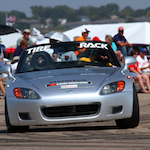
You are talking about a condition like below and going over a large bump. This is Bob Endicott from the SD Tour and he's obviously at or close to full lock and counter steering. This is the only way I can see having any speed. I would also not want to have high compression at full lock like that either.

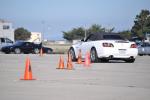
Another SD Tour shot of Jeff Cawthorne, but in a very high speed sweeper with high loading, not at lock, and not an S2000.

Former Moderator
Joined: May 2006
Posts: 14,847
Likes: 10
From: Emmett
When I install my suspension I jack up the control arm and then tighten the lower shock bolt as well as the upper control arms to prevent the bushings from tearing. I just do 14" to center of hub.
With this done the bushings are actually stronger than helper springs and the suspension does not extend past the relation of spring to bushing tension so my shocks never see full droop.
Right now I don't run helpers and my 650/550lb springs are always captured even when going up steep driveways.
With this done the bushings are actually stronger than helper springs and the suspension does not extend past the relation of spring to bushing tension so my shocks never see full droop.
Right now I don't run helpers and my 650/550lb springs are always captured even when going up steep driveways.

Registered User

Joined: Nov 2000
Posts: 1,785
Likes: 1
From: Azusa
Supposing you are at full droop and enough lock for the wheel to rub the control arm. I'm thinking that the wheel stops pretty quickly in that situation. Probably quick enough not to cause more than superficial damage.

Registered User
Joined: Sep 2006
Posts: 390
Likes: 0
i find it amazing that only now with the 949 wheels ppl are complaining about this problem (if it exist)...
TR wheels same width and offset no?
and Volks?
not to mention under load wheels flex.. so even if they aren't exact same offset and width they might touch under this extreme case.
TR wheels same width and offset no?
and Volks?
not to mention under load wheels flex.. so even if they aren't exact same offset and width they might touch under this extreme case.
Joined: May 2004
Posts: 1,531
Likes: 3
From: Tucson
Originally Posted by 1_slow_s2000,Jun 25 2010, 10:00 AM
i find it amazing that only now with the 949 wheels ppl are complaining about this problem (if it exist)...
TR wheels same width and offset no?
and Volks?
not to mention under load wheels flex.. so even if they aren't exact same offset and width they might touch under this extreme case.
TR wheels same width and offset no?
and Volks?
not to mention under load wheels flex.. so even if they aren't exact same offset and width they might touch under this extreme case.
I just attribute all the noise on this to people (and internet) that are new to them and trying to evaluate and understand a potential problem they are hearing about that is not going to be encountered by many at all.

Registered User
Joined: Jun 2007
Posts: 626
Likes: 0
From: Winnipeg, MB, Canada
Rob nailed it: Had I bought TRs or Volks I likely would have observed the exact same thing about them and posted here. I'm not picking on 949, just making an observation.
I'm probably being over-cautious. My career depends on that over-cautious critical thinking because people do stuff to vehicles that you would never expect, that's why OEM suspensions are designed with so much clearance.
I could share stories in person but won't post examples on the internet, mainly because I like my job.
I'm probably being over-cautious. My career depends on that over-cautious critical thinking because people do stuff to vehicles that you would never expect, that's why OEM suspensions are designed with so much clearance.
I could share stories in person but won't post examples on the internet, mainly because I like my job.


Joined: Apr 2010
Posts: 570
Likes: 16
Originally Posted by macr88,Apr 2 2010, 08:34 AM
number 14 in this image
the distance between 12 and 5 needs to be greater when compressed than the distance between the bottom of the threads and the point at which those pieces rest on the shaft (the little lip on the shaft)

the distance between 12 and 5 needs to be greater when compressed than the distance between the bottom of the threads and the point at which those pieces rest on the shaft (the little lip on the shaft)
The two washers on those bushings are supposed to clamp that sleeve. If that sleeve is not touching and tight against both washers then the shock shaft nut isn't tight enough or the shaft isn't threaded low enough. If it's not threaded low enough then you will need to just add some washers untill the distance is taken up and the sleeve is sandwiched.
+1 to this. If you haven't you are hearing the wonderful Honda phenomenon known as: "shock knock". As those top mount bushings compress over time, they start bottoming out against that collar creating a rattle noise. Either take the collar out or disassemble the top mount and shorten the collar with a saw or dremel with a cut-off attachment.
Either increase the shock nut torque, thread the shock shaft deeper, or simply remove number 14.
Does that sound all right?